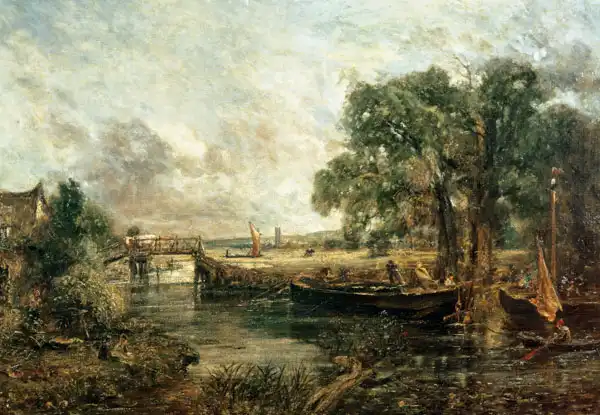
Stour cerca de Dedham
ID:
#2380 |
Romanticismo |
PaisajesAño de creación:
19th centuryVersión:
oil on canvasOriginal guardado:
Royal Holloway and Bedford New College, Surrey, UK Texto traducido automáticamente. ¡Disculpe los errores! John Costable fue un pintor inglés que capturó una serie de un paisaje inglés típico en una serie de seis pinturas. Específicamente, es el entorno de Dedham, cerca de Suffolka, donde su padre tenía una granja. Pasó su infancia aquí, así que no es de extrañar que le haya gustado este lugar. Constable también fue uno de los pocos artistas que capturó el clima en sus pinturas sobre la base de sus propios estudios de libros meteorológicos. El sombrío cielo da un toque de mal tiempo. Sin embargo, el espectador no está seguro de si la tormenta ha pasado o si acaba de venir. La imagen también son detalles notables, ya sean barro en el río, pastoreando un caballo blanco o una mujer en un niño de puente. Un elemento importante de la imagen es la iglesia discreta en el horizonte. Es una iglesia anglicana que cierra el ciclo de la vida y la eternidad divina.
Constable pintó un cuadro Stour cerca de Dedham en el año 19th century. Los colores predominantes de esta imagen son marrón y tu formato es paisaje. La ubicación del cuadro original es Royal Holloway and Bedford New College, Surrey, UK. Si lo desea, imprimimos una reproducción de esta imagen. Puedes elegir el tamaño y el diseño de la reproducción.
John Constable (1776 - 1837). English painter during
Romanticism. He was the son of a miller in Suffolk County and since childhood, he dreamed of becoming one of the best landscape painters of the 19th century. At last, painting really became the sole purpose of his existence. In December 1817, he moved to London with his wife, and there the first of their seven children was born. Children then followed almost invariably each year, but it was very difficult and exhausting to feed such a large family. Landscape painting was not recognized nor a much profitable profession in England in the 19th century. John and Mary worked very hard, which later destroyed their health. Despite this, however, gradually the first significant successes arrived. In 1819, John Constable became an associate member of the Royal Academy of Arts.
Two years later, he painted his most famous work
Hay Wagon. He exhibited it in London, but he came to fame in 1824 when this image received the gold medal at the Salon in Paris. The local appraisal was full of recognition, but in England his work was viewed with reserve. A year later, although he was accepted as a full member of the Royal Academy of Arts, he exhibited a grim picture, Hadleigh Castle, which expressed grief over the death of his wife. He entrusted their seven children to a nurse, but he still cared for them very well and conscientiously. A very renowned piece is
Wivenhoe Park of 1816. In 1833, however, he fell ill and was greatly plagued by old age. To conserve his strength, he painted only less demanding watercolours. Finally, Constable died after a stroke in 1837. His paintings were sold for a small amount auction, and his work achieved recognition many years later.


 776 273 496
 Follow us on Facebook
 Follow us on Instagram