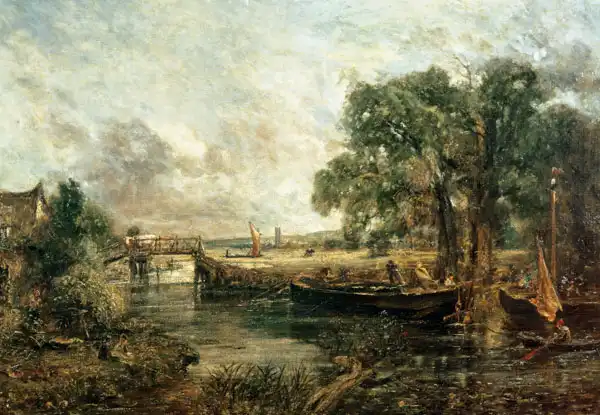
Stour vicino a Dedham
ID:
#2380 |
Romanticismo |
PaesaggiAnno di creazione:
19th centuryDesign:
oil on canvasOriginale salvato:
Royal Holloway and Bedford New College, Surrey, UK Testo tradotto automaticamente. Per favore, scusa eventuali errori! Giovanni è stato un pittore inglese che ha catturato una serie di un tipico panorama inglese in una serie di sei dipinti. In particolare, è l'ambiente circostante di Dedham, vicino a Suffolka, dove suo padre aveva una fattoria. Ha trascorso la sua infanzia qui, quindi non c'è da stupirsi che gli piacesse questo posto. Constable è stato anche uno dei pochi artisti che hanno catturato il tempo nei suoi dipinti sulla base dei suoi studi sui libri meteorologici. Il cielo cupo dà un pizzico di maltempo. Tuttavia, lo spettatore non è sicuro che la tempesta sia passata o sta arrivando. L'immagine è anche notevole dettagli, che si tratti di fango nel fiume, al pascolo di un cavallo bianco o di una donna su un bambino di razza. Un elemento importante dell'immagine è la chiesa poco appariscente all'orizzonte. È una chiesa anglicana che chiude il ciclo della vita e l'eternità divina.
Constable ha dipinto il quadro Stour vicino a Dedham nell'anno 19th century. I colori predominanti di questo quadro sono marrone e il suo formato è paesaggio. L'ubicazione del quadro originale è Royal Holloway and Bedford New College, Surrey, UK. Su richiesta, stampiamo una riproduzione di questo quadro; puoi scegliere le dimensioni e il design della riproduzione.
John Constable (1776 - 1837). English painter during
Romanticism. He was the son of a miller in Suffolk County and since childhood, he dreamed of becoming one of the best landscape painters of the 19th century. At last, painting really became the sole purpose of his existence. In December 1817, he moved to London with his wife, and there the first of their seven children was born. Children then followed almost invariably each year, but it was very difficult and exhausting to feed such a large family. Landscape painting was not recognized nor a much profitable profession in England in the 19th century. John and Mary worked very hard, which later destroyed their health. Despite this, however, gradually the first significant successes arrived. In 1819, John Constable became an associate member of the Royal Academy of Arts.
Two years later, he painted his most famous work
Hay Wagon. He exhibited it in London, but he came to fame in 1824 when this image received the gold medal at the Salon in Paris. The local appraisal was full of recognition, but in England his work was viewed with reserve. A year later, although he was accepted as a full member of the Royal Academy of Arts, he exhibited a grim picture, Hadleigh Castle, which expressed grief over the death of his wife. He entrusted their seven children to a nurse, but he still cared for them very well and conscientiously. A very renowned piece is
Wivenhoe Park of 1816. In 1833, however, he fell ill and was greatly plagued by old age. To conserve his strength, he painted only less demanding watercolours. Finally, Constable died after a stroke in 1837. His paintings were sold for a small amount auction, and his work achieved recognition many years later.


 776 273 496
 Follow us on Facebook
 Follow us on Instagram